1/ Introduction to Vacuum Pumps
A vacuum pump is a mechanical or electromechanical device designed to remove gas molecules, water vapor, and other volatile substances from a sealed chamber, creating an environment with pressure lower than atmospheric pressure - i.e., a vacuum.
2/ Operating Principles
Most vacuum pumps operate by establishing a pressure differential between the pump chamber and the target enclosure. As the pump chamber pressure is lowered, gas molecules in the chamber migrate into the pump to equalize the pressure. The gas is then compressed and expelled through the exhaust port, repeating the suction - compression - exhaust cycle continuously to maintain the desired vacuum level.
The main mechanisms for creating this pressure differential include:
- Positive displacement: piston, rotary vane, diaphragm
- Dynamic (high-vacuum): jet ejector, diffusion, turbomolecular
3/ Construction and Main Components
A typical vacuum pump consists of:
- Pump chamber
- Pressure-generating mechanism (piston, vane, rotor, etc.)
- Check valves (inlet/outlet)
- Drive motor
- Sealing system (seals, gaskets)
- Lubrication system (oil, grease, or inert gas)
- Control and protection units (pressure switches, temperature sensors, filters)
4/ Classification of Vacuum Pumps
Vacuum pumps are categorized by operating principle and structure:
4.1/ Positive Displacement
- Piston Pump
- Rotary Vane Pump
- Liquid Ring Pump
4.2/ Dynamic (High Vacuum)
- Jet Ejector Pump
- Diffusion Pump
- Turbomolecular Pump
- Roots Blower
Classification by Vacuum Level
|
Vacuum Range |
Corresponding Pressure |
|---|---|
|
Low Vacuum |
p > 100 Pa |
|
Medium Vacuum |
100 Pa > p > 0.1 Pa |
|
High Vacuum |
0.1 Pa > p > 10⁻⁵ Pa |
|
Ultra-High Vacuum |
p < 10⁻⁵ Pa |
|
|
|
Green and Energy-Efficient Vacuum Technologies
Emerging sustainable trends include:
- Dry Pumps: oil-free operation reduces environmental contamination and oil disposal costs
- Maglev Turbomolecular Pumps: magnetic levitation rotors minimize friction, energy use, and maintenance
5/ Technical Specifications and Evaluation Criteria
- Ultimate Vacuum: Lowest achievable pressure
- Pumping Speed: Volume of gas pumped per unit time (L/min, m³/h)
- Throughput: Gas mass flow rate through the pump, indicating sustained vacuum capability
- Power Consumption: Rated energy usage during operation
- Noise and Vibration: Impact on working environment
- Operating Temperature: Permissible thermal range
6/ Selection Criteria for Vacuum Pumps
When selecting a vacuum pump, consider:
- Required ultimate pressure and pumping speed
- Nature of the process media: moisture, particulates, corrosive vapors
- Installation environment and space constraints
- Maintenance requirements (oil changes, cleaning intervals)
- Capital and operating costs
7/ Applications of Vacuum Pumps
Vacuum pumps are indispensable in industries such as:
- Medical and pharmaceutical (aspiration, sterilization)
- Electronics and semiconductor manufacturing (degassing, packaging)
- Chemicals and petrochemicals (distillation, evaporation)
- Food and packaging (drying, vacuum packaging)
- Wood and plastics processing (drying, vacuum forming)
Vacuum Pumps in SEM Laboratories
Scanning Electron Microscopes require sample-chamber pressures around 10^(-6)Torr
A typical vacuum chain includes:
- A rotary vane roughing pump reduces pressure to about 10 ^(-1)Torr.
- A Maglev turbomolecular pump further lowers pressure to 10^(-6)Torr.
- Automated PLC-controlled valves regulate chamber isolation during sample exchanges.
8/ Maintenance, Operation, and Troubleshooting
- Change and monitor oil quality at regular intervals
- Clean or replace inlet and exhaust filters
- Inspect wear on vanes, pistons, and seals
- Operate within recommended pressure and speed limits; avoid overload
- Diagnose and fix leaks, excessive vibration, or abnormal noise
9/ Conclusion and Future Trends
Vacuum pumps increasingly incorporate digital controls, remote monitoring, and energy-optimization features. Hybrid solutions - combining positive-displacement and dynamic stages - are trending, enabling higher vacuum levels with lower operational costs.
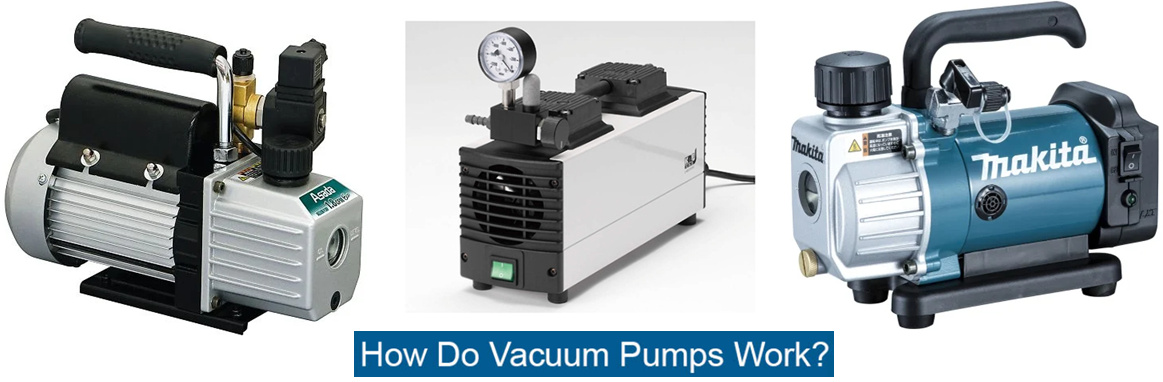
Today, QTE Technologies is one of the leading suppliers of vacuum pumps from many famous brands such as AS ONE, ASADA, KNF, MAKITA,...
QTE Technologies is proud to be a global MRO supplier, serving customers in more than 180 countries and always striving to ensure customers have a complete and satisfied experience. We were established in 2010, providing more than 1 million products for every industry and science and technology. In addition, you can contact us anytime via 24×7 chat support, phone, WhatsApp or email. Discover what our valued customers say about our services on our dedicated review page.
Author: Editorial Board of QTE Technologies (with a strong background in both engineering and innovation - accumulated over 15 years of experience).