
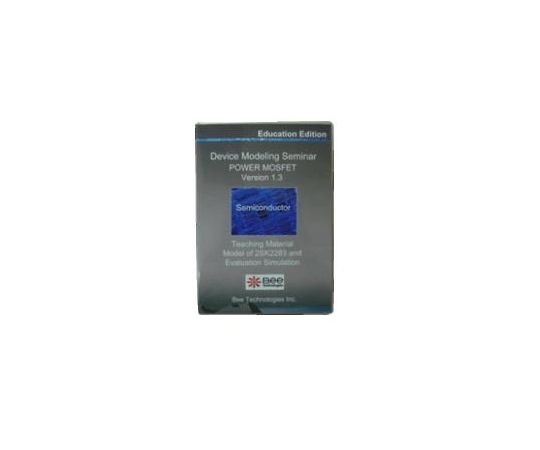
Bee Technology DM-004 Device Modeling Teaching Materials Power MOSFET Edition
| Manufaturer: | Bee Technology |
| Model: | DM-004 |
Product code
111-63915
Price
292.85 USD
*The above price is Standard Price, Kindly click on Request a quote  to unlock Competitive Pricing and Delivery Dates - Check Availability. Our expert consulting team is always ready to assist you within one business day.
*Order Process: 1. Request a quote ⇒ 2. Quote via Email ⇒ 3. Proforma Invoice ⇒ 4. Payment ⇒ 5. Delivery and Invoice.
*We deliver to your doorstep under DAP terms. Customs clearance is for your account.

*You can't find the product you need, please send us the picture/specifications/model/product code and quantity you need to email: [email protected]. We will find it for you.
*Review us here: Review Now 
Description
- 20% off for a limited time only! [Summary]
- This is a teaching material for device modeling of power MOSFETs, which play a key role in power electronics.
- A power MOSFET consists of a main MOSFET and a body diode.
- We explain the key points, precautions, and optimal modeling process for each device.
- We hope you will use this to gain an understanding of power MOSFETs.
- 【table of contents】
- 1. About Device Modeling
- 2. Device modeling of power MOSFET
- Power MOSFET
- 2.1 How to determine the constants L, W, and TOX
- 2.2 Extraction method of KP
- 2.3 How to extract VTO
- 2.4 Extraction method of RD
- 2.5 How to extract RDS
- 2.6 Extraction method of CGSO and CGDO
- 2.7 Extraction method of MJ and PB
- 2.8 Extraction method of RG
- Body Diode
- 2.9 Extraction method of IS, N, RS, and IKF
- 2.10 How to extract TT (trj)
- 2.11 How to write a subcircuit
- 3. How to evaluate device models
- Power MOSFET
- 3.1 Simulation and evaluation of Vgs-ld characteristics
- 3.2 Evaluation, analysis and simulation of Rds(on) Resistance
- 3.3 Simulation and evaluation of gate charge characteristics
- 3.4 Evaluation and analysis simulation of capacitance characteristics (VdS vs. Cbd)
- 3.5 td(on) evaluation, analysis and simulation
- Body Diode
- 3.6 Evaluation, analysis and simulation of Vsd vs. ls characteristics
- 3.7 Evaluation, analysis and simulation of reverse recovery characteristics
- 4. Weaknesses of the model (gate charge characteristics)
- 5. Thermal device model
- 6. Question and Answer Session
You may like




Sign up for the newsletter - the opportunity to receive promotions